Boulevard Garden and Maintenance By-law
Homeowners, tenants, and neighbourhood gardeners!
Let us know where you’re planning to plant a garden.
All boulevard gardeners must sign the Declaration Acknowledgement Agreement before they establish a garden.
Complete a physical Declaration Acknowledgment Agreement at City Hall, or learn how to acknowledge and declare your garden online.
Submit your Boulevard Garden Declaration
Establishing a Boulevard Garden
Creating a Boulevard Garden can help slow biodiversity loss, and help reduce the impacts of climate change and food insecurity. Join the movement and help transform our City by planting a boulevard garden today!
What to Plant in a Boulevard Garden
The City of Thunder Bay’s Boulevard Garden and Maintenance By-law allows you to grow a wide variety of herbaceous plants and small shrubs in your boulevard garden. There are many different plant species, so it can be hard to know where to start.
The City encourages you to plant native species whenever possible. Native plant species are awesome at restoring native habitat. They compete with invasive species, create habitat for other native wildlife, and generally require less maintenance than their non-native counterparts.
Learn more about the native species that you can plant in your garden with information from the Lakehead Region Conservation Authority Native Plants of Northwestern Ontario.
Height Restrictions and Set-backs
Keep the following height restrictions and set-back distances in mind as you plan your garden.
Garden Boxes and Support Structures
Please keep the following rules in mind when building a garden box:
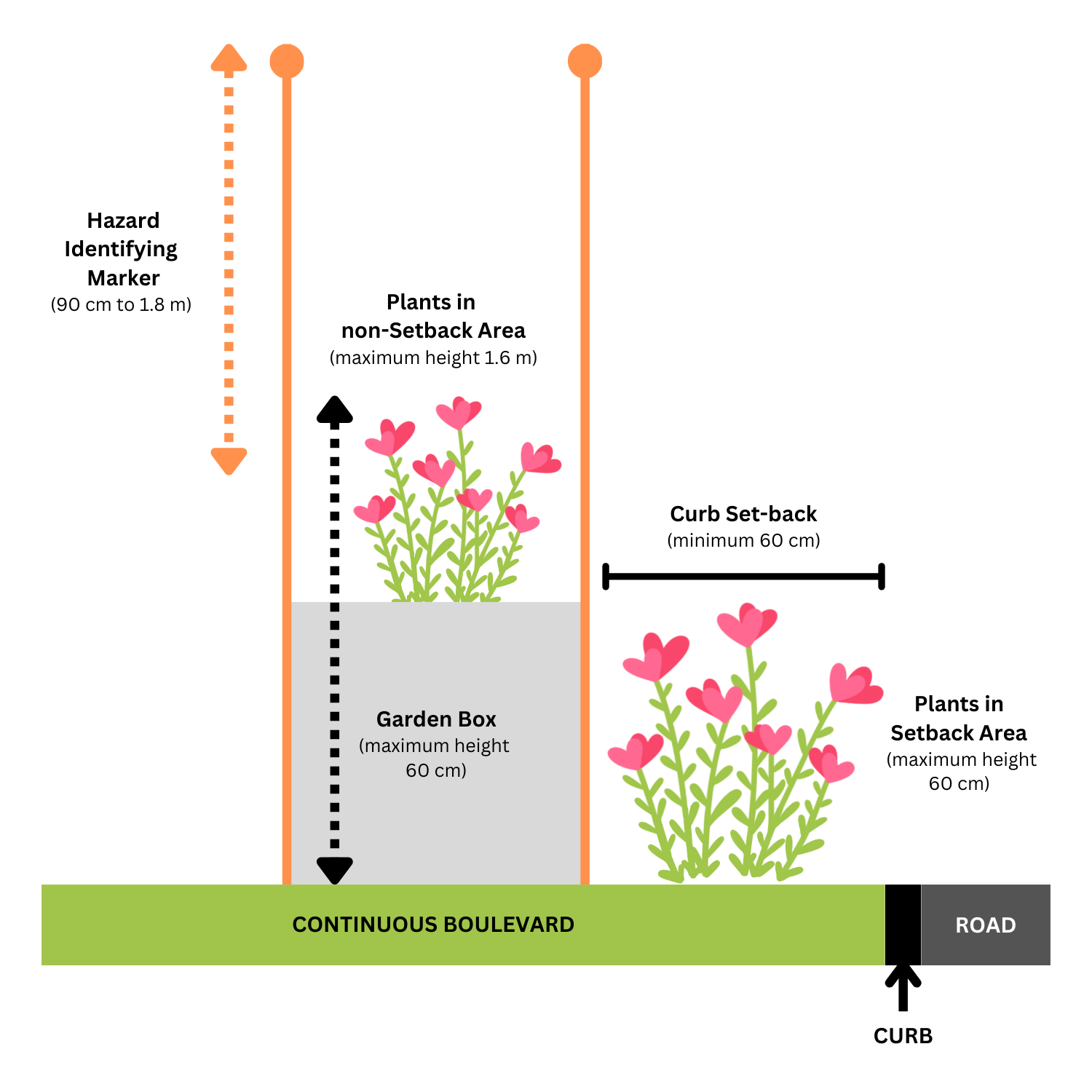
- The maximum height limit for garden boxes is 60 cm.
- Garden boxes must be made of smooth, untreated wood.
- Each corner of a garden box must be flagged with a winter safety hazard marker year-round. These markers must have reflective tops, be securely fixed to each corner, and measure between 0.91 m and 1.8 m in height. They should not exceed 2.5 cm in diameter and should not be made of rock, concrete, or steel products like t-bars and rebar.
- Garden Boxes can be decoratively painted or stained.
- Garden boxes can display one 10 cm X 25 cm address identification plate, but should not display any other signs, advertising, graphics, images, or posters.
- The total height of the garden box and the plants grown inside of it cannot be taller than 1.6 m.
- If the combined total height of the garden box and the plants growing inside it exceeds 1.0 m in height, gardeners must follow the alternating planting prescription for maximum growth height plants. Please see “Height Restrictions and Set-backs” for more information.
- Garden boxes cannot be placed in any set-back areas. Please see “Height Restrictions and Set-backs” for more information.
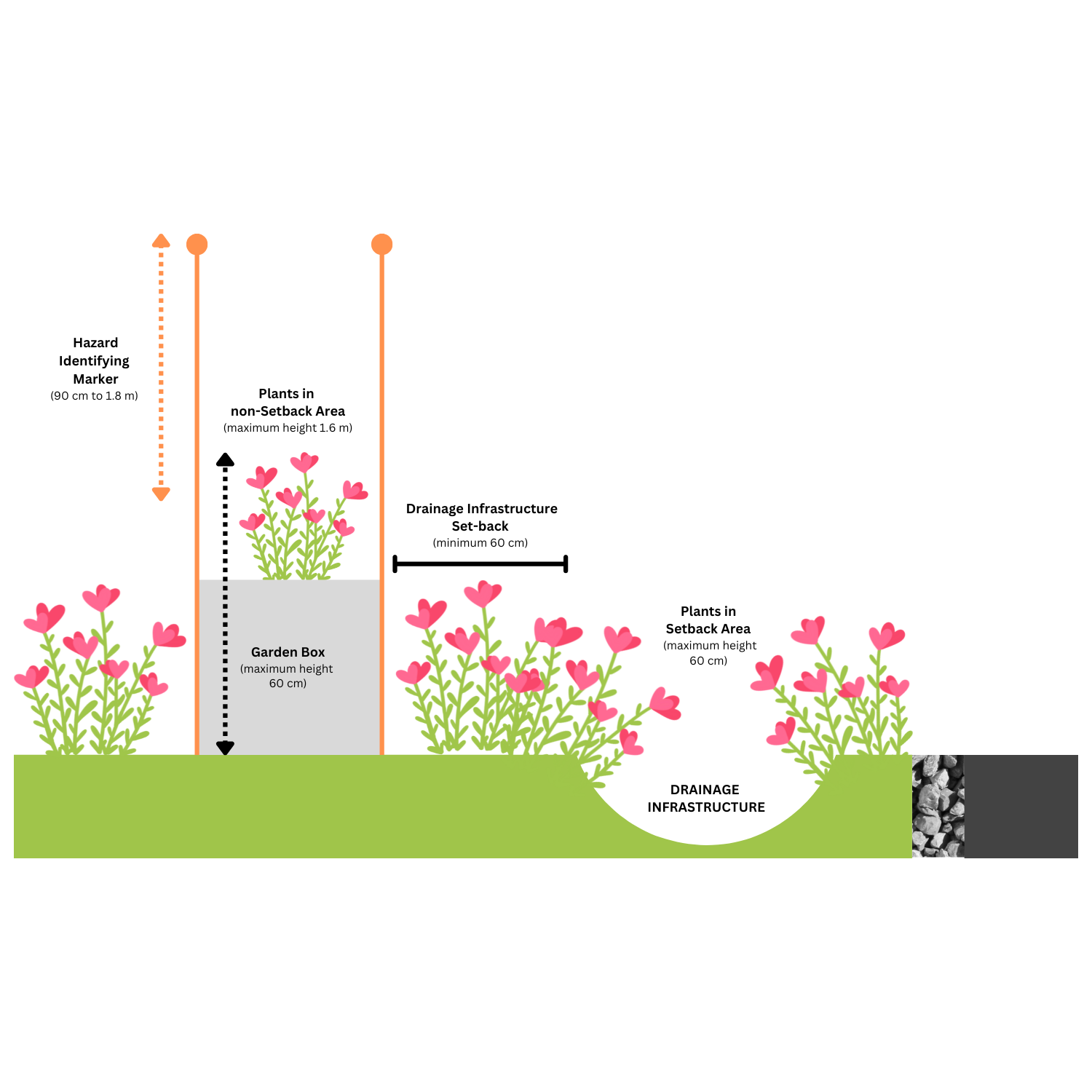
- Garden boxes must be set-back by 60 cm from the closest edge of any slope, ditch, or drainage swale.
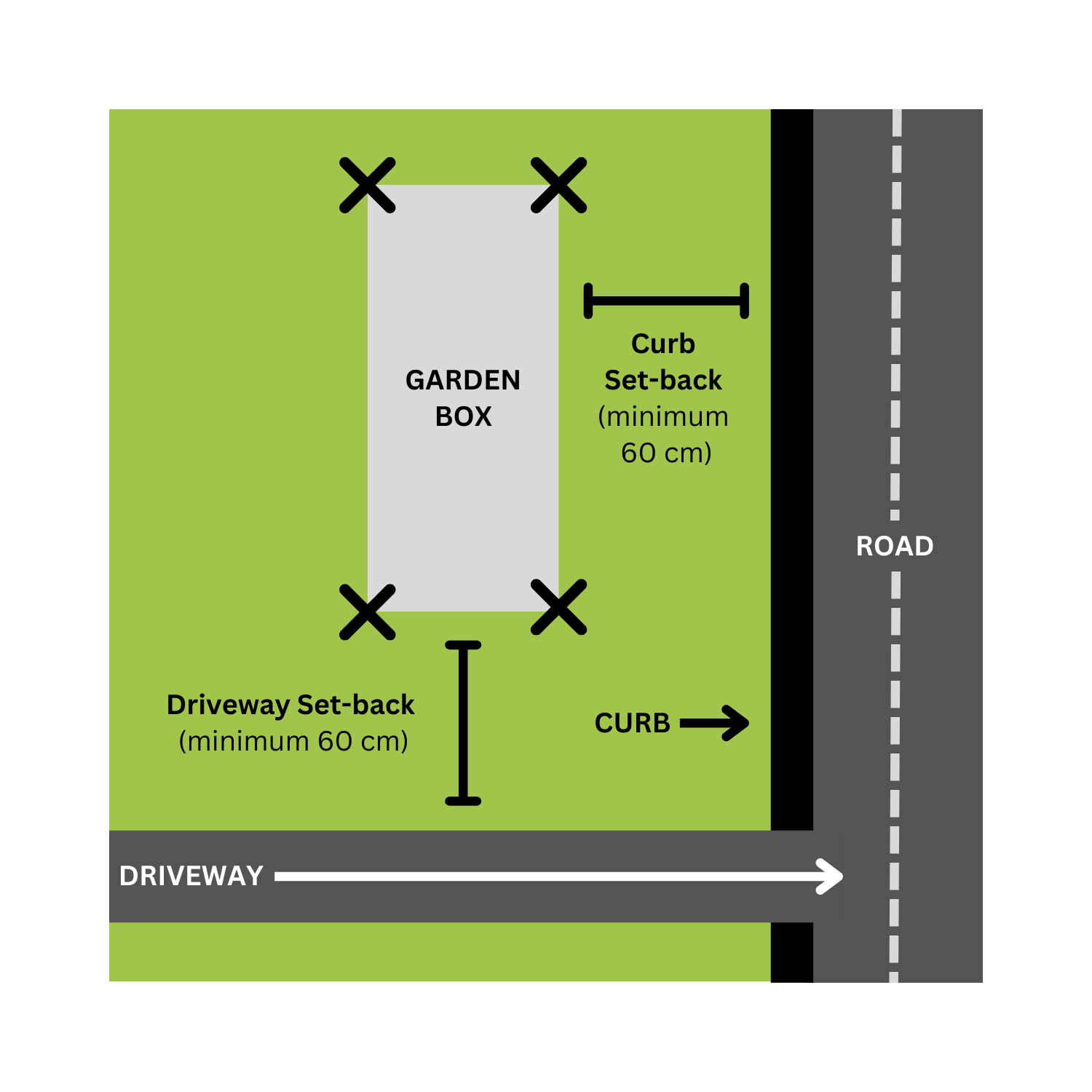
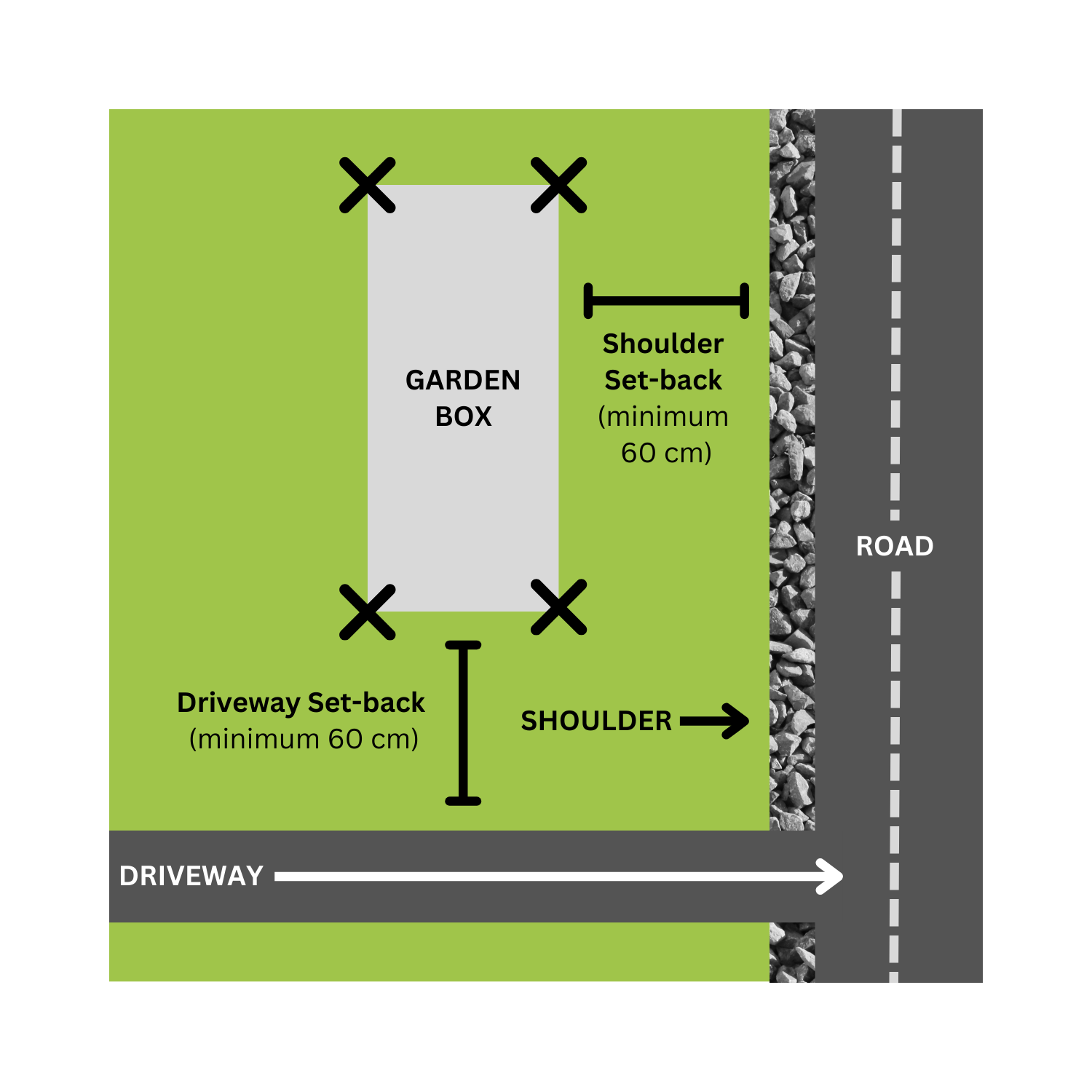
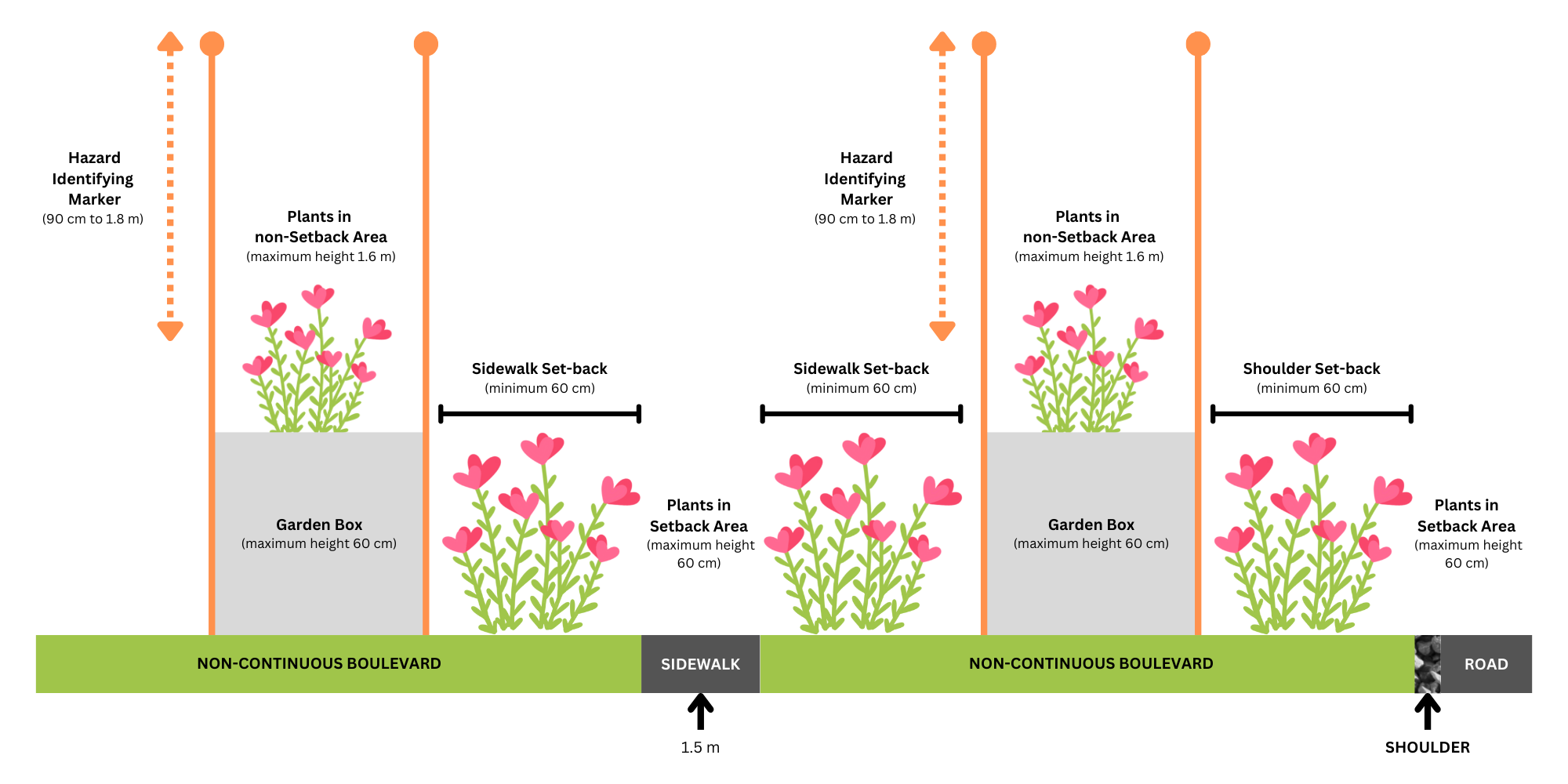
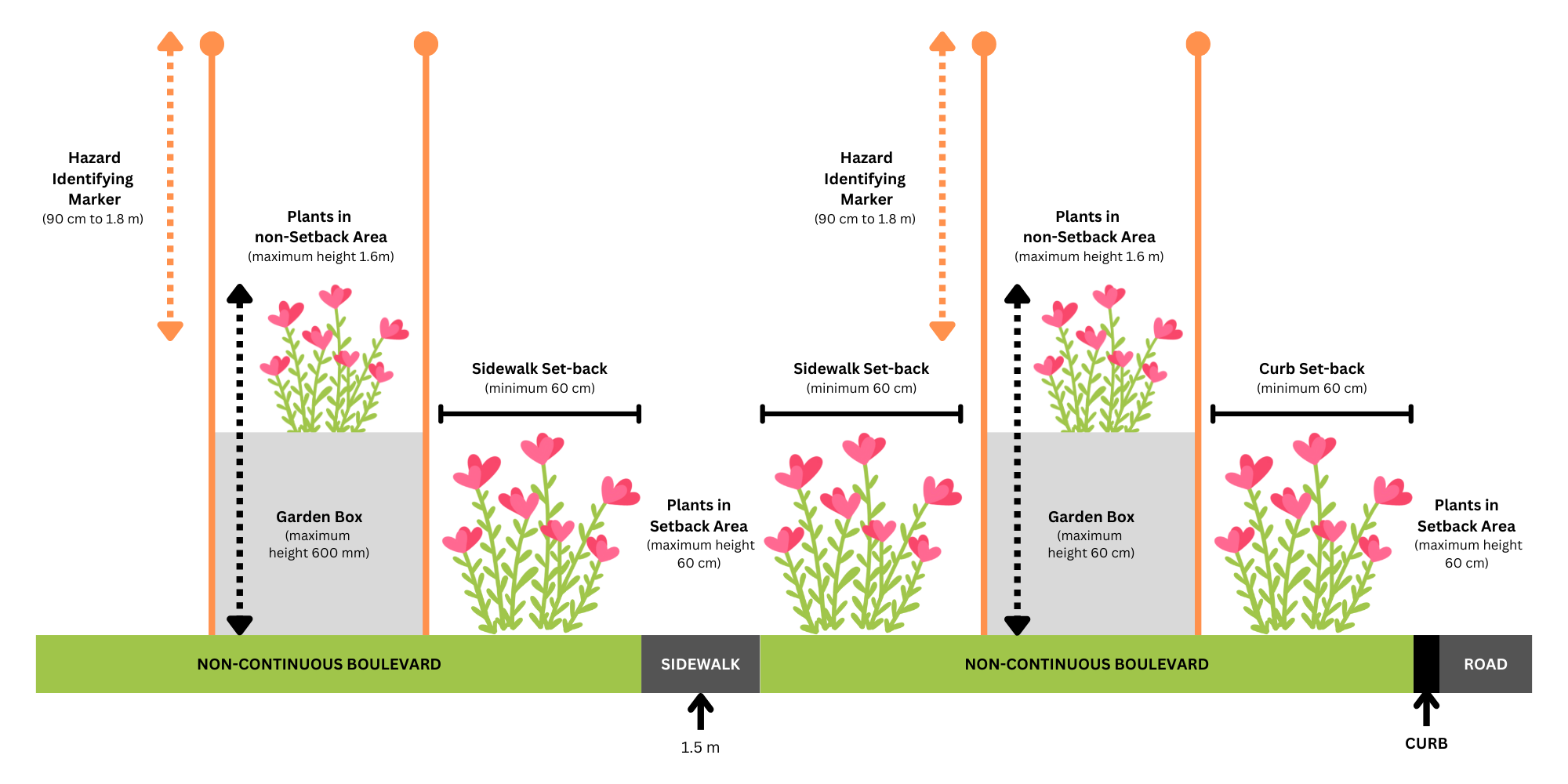
- Plant support structures such as stakes, poles, and cages must be fully contained within the garden box and cannot exceed 1.6 m in combined total height.
- Plant support structures must be removed annually by November 15.
- You cannot grow shrubs in your garden box.
Edible Plants
Salt, sand, and other de-icing agents are used on Thunder Bay’s roads and sidewalks throughout the winter months. When the snow and ice melt in the spring, these chemicals find their way onto the boulevard and react with the soil to make bioavailable heavy metals. When fruit or vegetables are planted in these contaminated soils, they can pass along the harmful heavy metals to people who eat that fruit or vegetable.
The City of Thunder Bay cannot provide any information about the soil composition of residential boulevards. For your safety, you should have your soil tested for bioavailable heavy metals before you start growing edible plants. For more information on soil testing, please contact Lakehead University’s Environmental Laboratory at 807-343-8010, extension 8179.
Street Trees
The Parks and Open Spaces Division maintains the integrity of our urban forest canopy by planting and maintaining trees on boulevards throughout the City. This work is carefully planned as outlined in the Urban Forest Management Plan, the Climate Adaptation Plan, and the Net-Zero Strategy!
The Boulevard Garden and Maintenance By-law does not allow participants to plant trees in the boulevard area. If you would like a street tree planted in the boulevard area, contact Infrastructure and Operations Dispatch at 807-625-2195.
Please note that some boulevard locations will not qualify for street tree planting due to space and utility restrictions. Boulevard areas will be assessed by qualified individuals who will consider the requirements of a tree to survive at that site. They will account for nearby paving, overhead wires, permeable growing space, and underground utilities before planting occurs.
Invasive Species and Prohibited Plants
Please help us avoid the negative effects of invasive species. Do not plant the following invasive species in your boulevard garden:
- Amur maple (Acer tataricasspginnala)
- Autumn Olive (Elaeagnusumbellata)
- Canada thistle (Cirsium arvense)
- Common buckthorn (Rhamnus cathartica)
- Creeping jenny (Lysimachianummularia)
- Dame’s rocket (Hesperismatronalis)
- Daylily (Hemerocallis fulva)
- Dog-strangling vine, also known as black swallowwort and pale swallowwort (Cynanchum rossicum; Cynanchum louiseae)
- English ivy (Hedera helix)
- Euonymus, Wintercreeper (Euonymus fortunei)
- Garlic mustard (Alliaria petiolata)
- Giant hogweed (Heracleum mantegazzianum)
- Glossy buckthorn (Frangula alnus)
- Goutweed (Aegopodium podagraria)
- Himalayan Balsam (Impatiens glandifulera)
- Italian honeysuckle (Lonicera caprifolium)
- Japanese barberry (Berberis japonica)
- Japanese honeysuckle (Lonicera japonica)
- Japanese knotweed (Reynoutria japonica var. japonica)
- Lily of the valley (Convallaria majalis)
- Manitoba maple, box elder (Acer negundo)
- Members of the Family Cannabaceae (Includes Cannabis Sativa)
- Miscanthus, silvergrass (Miscanthus sacchariflorusand M. sinensis)
- Multiflora rose (Rosa multiflora)
- Norway maple (Acer platenoides)
- Oriental bittersweet (Celastrus orbiculatus)
- Ornamental honeysuckles including: Tatarian (Lonicera tatarica), Amur (L. maackii), Morrow (L. morrowii), and Bells(L.×bella) honeysuckles.
- Pachysandra, Japanese spurge (Pachysandra terminalis)
- Pants or fungi (mushrooms) which have potential hallucinogenic properties.
- Periwinkle (Vinca minor)
- Phragmites (Phragmites australis subsp. australis)
- Poison ivy (Toxicodendron radicans)
- Purple loosestrife (Lythrum salicaria)
- Ragweed (Ambrosia artemisiifolia)
- Russian olive (Elaeagnus angustifolia)
- Sea buckthorn (Hippophaerhamnoides)
- Spearmint (Mentha spicata)
- Stinging Nettle (Urtica dioica)
- Tree-of-heaven (Ailanthus altissima)
- White mulberry (Morus alba)
- Winged burning bush (Euonymus alatus)
- Yellow archangel (Lamium galeobdolonsyn, Lamiastrum galeobdolon)
How to Protect Private Utilities and Public Infrastructure
Protect stormwater infrastructure by making sure that your boulevard garden:
- Does not fill the bottom of slopes, ditches, or drainage swales.
- Does not drastically change the existing bed height, designed elevation, or grade of the boulevard area. This means that you should not be adding or taking soil out of the boulevard area unless you choose to build a garden box.
- Does not contain impervious materials like rocks and concrete. You may choose to design a small walkway through your garden, but it should be placed at or below the grade of nearby curbs and sidewalks and it should not cover more than 5% of the total boulevard area.
Internet cables, water and wastewater pipes, electrical transformers, and City trees are housed in your boulevard, too! Protect this infrastructure by:
- Learning where your underground utilities are located before you begin to dig. Visit www.ontarioonecall.ca/homeowners to request a utility locate today.
- Hand digging in the boulevard area using small gardening tools rather than mechanical equipment or large spades.
- Avoiding the use of hard landscaping features such as stone, brick, and concrete.
- Making sure that water shut-off valves are easily accessible for workers who may have to access them quickly.
Maintaining a Boulevard Garden
If you do not choose to plant a boulevard garden, the turfgrass in your boulevard area should not grow over 20 cm in height. Naturalized boulevard gardens should be intentionally planted and maintained. You cannot create a naturalized boulevard garden by letting the turfgrass on boulevards grow freely because naturalized gardens use specific plants to mimic the region’s natural landscape.
Preventing Nuisance Litter and Waste
Anyone who establishes or maintains a boulevard garden should keep the boulevard area free of litter and other waste materials.
Litter and waste materials include:
- Objects that create immediate tripping hazards for pedestrians.
- An accumulation of rotting fruits or vegetables that creates foul odours or attracts unwanted wildlife.
- Improperly aged compost.
- Bulky items like appliances or furniture.
- Old vehicles, lawn mowers, lawn tractors, motor-powered equipment, or any of their parts.
- Broken concrete, patio stones, bricks, or pallets.
- Unused building materials or discarded demolition materials.
- Yard waste.
- Fallen trees or tree limbs larger than 5 cm in diameter.
- Animal or human feces.
- Tires.
- Garbage, litter and other discarded items that may accumulate in the garden over time due to wind and other environmental factors.
When materials such as aged compost, yard waste, brush, and branches are integrated into a planned, naturalized garden area they are not considered nuisance litter or waste material. These naturalized garden features can create ideal habitats for native pollinators! For public safety, please do not place these items in set-back areas or in places where they may cause tripping hazards.
Safe Use of Pesticides, Herbicides, Rodenticides
Please do not use synthetic pesticides, herbicides, or rodenticides in your boulevard garden. The toxic chemicals found in store-bought pesticides are not selective – they will kill beneficial wildlife just as easily as pests.
You can avoid unwanted garden pests by:
- Keeping your soil healthy. This will support plant health and increase your garden’s resilience to pests.
- Understanding the lifecycle of pests and identifying the early stages of pest damage. Learn more about the biodiverse range of critters that live in your garden, and what growth stages are the easiest to control organically.
- Crop cycling edible plants. Plant different species year after year to maintain soil health and avoid pests that depend on specific plants to complete their life cycles.
- Maintaining high levels of biodiversity in your garden. Create habitats for birds and invertebrates that will eat your pests!
If you already have a pest infestation, try:
- Removing pests by hand, or with tools such as small gardening shovels or toothbrushes.
- Spreading diatomaceous earth in specific parts of your garden.
- Making homemade insecticidal soap and spraying it over targeted areas.
- Using crop or ground covers.
- Pouring vinegar or boiling water over specific herbaceous pests.
Instead of using store-bought fertilizers, try one of these eco-friendly alternatives:
- Spread aged compost over your garden bed. You can pick up aged compost for free at the City’s Solid Waste and Recycling Facility, or try making your own at home. Learn more about at-home composting by vising the EcoSuperior Website.
- Cover your garden bed with a thin layer of dried grass clippings.
- Make your own compost tea. Steep fruit and vegetable scraps in water for a few days, strain of solids, and then use the water to feed your garden.
- Mulch your garden bed. Just make sure that you are not raising the height of your garden bed.
- Crop cycle edible plants. Planting different species year after year can help you maintain the health of your soil.
These natural fertilizers are best applied after a rainfall. Moist soil will soak up nutrients more easily, and your compost will not be washed away by the rain.
Frequently Asked Questions
What plant species can I grow in my boulevard garden?
Try and plant native species whenever possible. Native plant species are awesome habitat restorers. They compete with invasive species, create habitat for other native wildlife, and generally require less maintenance than their non-native counterparts.
Learn more about the native species that you can plant in your garden with information from the Lakehead Region Conservation Authority Native Plants of Northwestern Ontario.
I have pests in my garden. How can I get rid of them?
Instead, you can try:
- Removing pests by hand, or with tools such as small gardening shovels or toothbrushes.
- Spreading diatomaceous earth in specific parts of your garden.
- Making your own insecticidal soap and spraying targeted areas.
- Using crop or ground covers.
- Pouring vinegar or boiling water over specific herbaceous pests.
What kind of fertilizer can I use in my boulevard garden?
Instead of using store-bought fertilizers, try:
- Spreading aged compost over your garden bed. You can pick up aged compost for free at the City’s Solid Waste and Recycling Facility, or try making your own at home! To learn more about at-home composting in Thunder Bay, please visit: www.ecosuperior.org/home-composting.
- Covering your garden bed in a thin layer of dried grass clippings.
- Making your own compost tea. Steep fruit and vegetable scraps in water for a few days, then use the water to feed your garden!
- Mulching your garden bed. Just make sure that you are not raising the height of your garden bed!
- Crop cycling edible plants. Plant different species year after year can help you maintain the health of your soil.
These natural fertilizers are best applied after a rainfall event. Moist soil will soak up nutrients more easily, and your compost will not be washed away!
Why is the City introducing the Boulevard Garden By-law?
Why do I have to declare and acknowledge my boulevard garden?
I inherited a boulevard garden from a previous owner. What do I do with it?
I am looking for a different unit of measurement.
Millimeters (mm) | Centimetres (cm) | Metres (m) | Inches (in) | Feet (ft) |
400 mm | 40 cm | 0.4 m | 15.7 in | 1.3 ft |
600 mm | 60 cm | 0.6 m | 23.6 in | 2.0 ft |
1000 mm | 100 cm | 1.0 m | 39.4 in | 3.3 ft |
1600 mm | 160 cm | 1.6 m | 63.0 in | 5.2 ft |
9000 mm | 900 cm | 9.0 m | 354.3 in | 29.5 ft |
Sign up to our Newsletter
Stay up to date on the city's activities, events, programs and operations by subscribing to our eNewsletters.