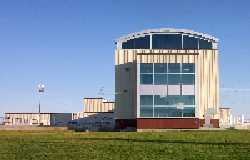
 Wastewater goes down the drains from our homes and businesses, travelling through
 Raw sewage, from across the City, is collected in large trunk sewers and flows, mainly by gravity, to the Main Pump Station at the Atlantic Avenue Water Pollution Control Plant.
In the Main Pump Station, the raw sewage is pumped to a Parshall flume, where the flow is measured. The sewage then passes through four mechanical bar screens. The bar screens remove large objects such as rags, paper, and wood debris, which is collected and hauled to the City’s Solid Waste and Recycling Facility for disposal.
From the bar screens, the sewage enters an aerated grit tank, where aluminum sulphate is added as the primary coagulant for phosphorus treatment. Heavier materials such as sand, gravel, and grain settle out in the tanks and are removed as grit. The grit is dewatered and sent to the City’s Solid Waste and Recycling Facility for final disposal. At the end of the grit tanks, polymer is added, as a flocculating agent to assist in further phosphorus and solids removal.
From the grit tank, sewage flows through an aerated distribution channel to four primary clarifiers. The clarifiers are large open tanks where the primary sludge solids are allowed to settle to the bottom. Settled organic solids, which include phosphorus, are continuously scraped from the bottom of the tanks and pumped to four anaerobic digesters. Scum, mainly grease, collected at the end of the clarifiers is separated by a rotary screen filter. The liquid scum is separated and thickened in the Dissolved Air Flotation (DAF) plant before being fed to the digesters. The scum screenings are conveyed to a compactor, where they are bagged and collected into a container then transferred to the City’s Solid Waste and Recycling Facility for final disposal.
The liquid portion leaving the primary clarifiers is called the primary effluent. This effluent goes to the Biofor® Biological Aerated Filter plant (BAF) to receive secondary treatment. The BAF plant provides the removal of biochemical oxygen demand (CBOD), total suspended solids, phosphorus and ammonia. There are eight carbonaceous filters to remove the majority of the particulate and CBOD from the wastewater and six nitrification filters to remove ammonia.
The waste generated (waste secondary sludge) in the filters is removed daily by a backwash and thickened by the DAF plant. Both aluminum sulphate and polymer are added to the waste secondary sludge to aid in phosphorus removal and the thickening process. Both the thickened waste secondary sludge and the primary sludge from the clarifiers are mixed in a sludge blend tank prior to being stabilized in the anaerobic digesters.
The anaerobic digesters retain the primary and secondary sludge for approximately 28 days. The content of the digesters are mixed and heated to a temperature of 35°C to support the breakdown of the sludge by the anaerobic bacteria. Digester gas, which contains methane, is produced during the anaerobic digestion process and is partially re‐ circulated in the digesters to provide mixing.
The excess digester gas is piped to a 600kW cogeneration engine to produce electricity and heat for the plant. If the engine is not utilizing the digester gas, it can be burned in any of the four plant boilers for fuel, supplying heat for the digestion process and plant buildings. If the boilers do not require the fuel, the thermal oxidation flare burns the surplus digester gas.
The digested sludge is transferred to the Sludge Dewatering Building where it is coagulated by polymer addition and then mechanically dewatered using high speed centrifuges. The dewatered sludge ‘cake’ or biosolids are hauled to the City’s Solid Waste and Recycling Facility for final disposal. The centrate (liquid separated from the dewatering process) is recycled to the plant Main Pump Station for re‐treatment.
The final plant effluent is discharged to the Kaministiquia River. During the period of April 15 to October 15 of each year, the final effluent is disinfected using ultraviolet light technology to reduce the discharge of bacteria during the recreational water use season.
 The City of Thunder Bay's Water Pollution Control Plant is participating in the Ontario Wastewater Surveillance Initiative. Under this initiative, communities across Ontario collect samples of their wastewater to be tested for evidence of COVID-19 in the population using the wastewater system. This initiative will help determine how wastewater surveillance can be used in conjunction with clinical data as a tool to inform a public health response.
 Wastewater Treatment Annual Report